Luis Heredia - Glossary 4
Luis Heredia - Glossary 4
10 Modulo de Transferencia de Calor & Ingles terms
These words will be part of the fourth activity of the module
- Convection heat transfer coefficient
- Noun
- The film coefficient, convection coefficient, or surface transmission coefficient, commonly represented as h, quantifies the influence of fluid, surface, and flow properties when convective heat transfer occurs.
- Example: Convection heat transfer is modeled with Newton's Law of Cooling
- en: Coeficiente de transferencia de calor por convección

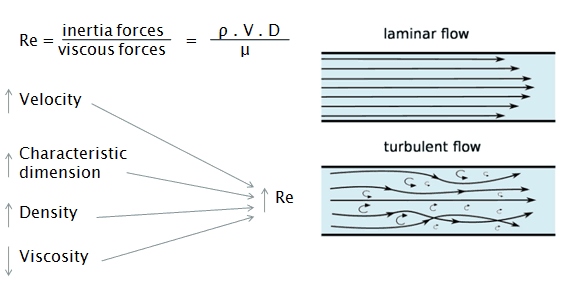
- Critical Reynold’s number
- Noun
- The critical Reynolds number is associated with the laminar-turbulent transition, in which a laminar flow becomes turbulent.
- Example: For flow in a pipe of diameter D, experimental observations show that for “fully developed” flow, the critical Reynolds number is about Red,crit = 2300.
- en: Número crítico de Reynolds
- Friction Coefficient
- Noun
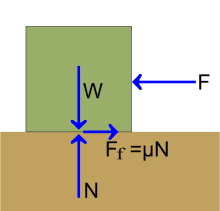
- The coefficient of friction or coefficient of friction links the opposition to sliding offered by the surfaces of two bodies in contact according to the intensity of the mutual support they experience. It is a dimensionless coefficient.
- Example: Ice on a polished steel sheet has a low coefficient; while the rubber on the pavement has a high coefficient. The coefficient of friction can take values from almost zero to not exceeding unity.
- en: Coeficiente de fricción
- Kinematic viscosity
- Noun
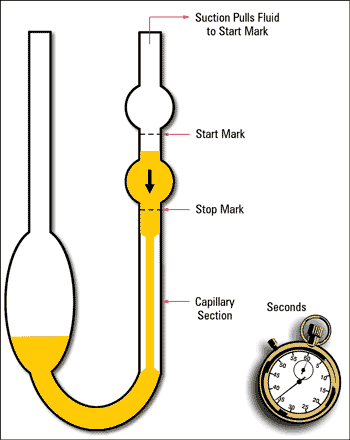
- The kinematic viscosity is an atmospheric variable defined as the ratio between the dynamic viscosity μ and the density ρ of the fluid, i.e. (7.25) and depends on both air temperature and pressure.
- Example: ost used oil analysis laboratories measure and report kinematic viscosity. By contrast, most onsite viscometers measure dynamic viscosity, but are programmed to estimate and report kinematic viscosity, so that the viscosity measurements reported reflect kinematic numbers reported by most labs and lube oil suppliers.
- en: Viscosidad cinemática
- Laminar flow
- Noun
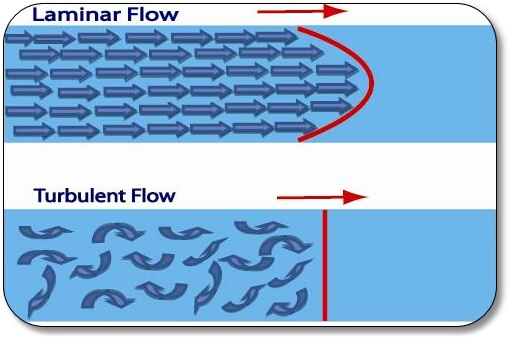
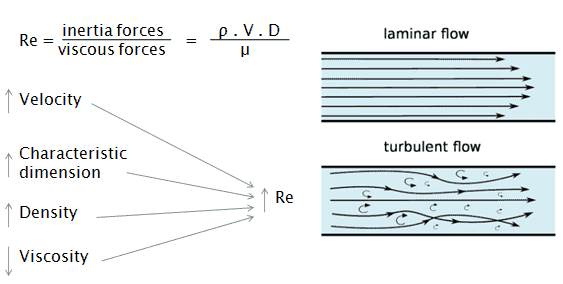
- Laminar flow or laminar current is called the movement of a fluid when it is ordered, stratified or smooth. In laminar flow, the fluid moves in parallel sheets without intermingling and each fluid particle follows a smooth path, called a streamline. In laminar flows, the lateral transport mechanism is exclusively molecular.
- Example: Laminar flow is typical of fluids at low velocities or high viscosities, while low viscosity, high velocity, or high flow fluid flows are often turbulent.
- en: Flujo laminar
- Nusselt number
- Noun
- a dimensionless parameter used in calculations of heat transfer between a moving fluid and a solid body.
- Example: The number of nusselt can be used to measure heat transmission
- en: Número de Nusselt

- Prandtl number
- Noun
- The Prandtl number (Pr) is a dimensionless number proportional to the quotient between the diffusion rate of the amount of moment (viscosity) and the thermal diffusivity.
- Example: It is named after the German engineer and physicist Ludwig Prandtl.
- en: Número de prandtl

- Reynold number
- Noun
- The Reynolds number (Re) is a dimensionless number used in fluid mechanics, reactor design, and transport phenomena to characterize the motion of a fluid. Its value indicates whether the flow follows a laminar or turbulent pattern.
- Example: In biology and in particular in biophysics, the Reynolds number determines the relationships between mass and speed of movement of microorganisms
- en: Número de Reynold
- Shear stress
- Noun
- The shear stress or shear stress is one that, fixed to a plane, acts tangentially to it. In prismatic parts, shear stresses appear when a shear force or a torsional moment is applied.
- Example: In elongated parts, such as beams and columns, the reference plane is usually one parallel to the cross section (that is, one perpendicular to the longitudinal axis).
- en: Tension cortante

- Turbulent flow
- Noun
- In terms of fluid dynamics, turbulence or turbulent flow is a flow regime characterized by low momentum diffusion, high convection, and rapid spatio-temporal changes in pressure and velocity. Non-turbulent flows are also called laminar flows.
- Example: In turbulent flow, it is assumed that vortices of different scales appear that interact with each other.
- en: Flujo turbulento
